Example:
See It in Action: How ownership changes over time in a simple 3-investor project?
This example shows how INEPHCO calculates ownership in a simple project with three investors who contribute the same amount at different times. The system then applies project expenses, inflation adjustment, and priority rights to determine each investor’s fair participation and final share.
Project Information:
- Project: Building a table
- Investors: Tom, Bob, Leo
- Initial contribution: $500 each
- Difference: Each investor enters the project at a different date
- Project duration in the example: 12 days
- Project expenses: 5 purchases recorded across the project timeline
- Inflation reference: The market price of a new table is used as the inflation index
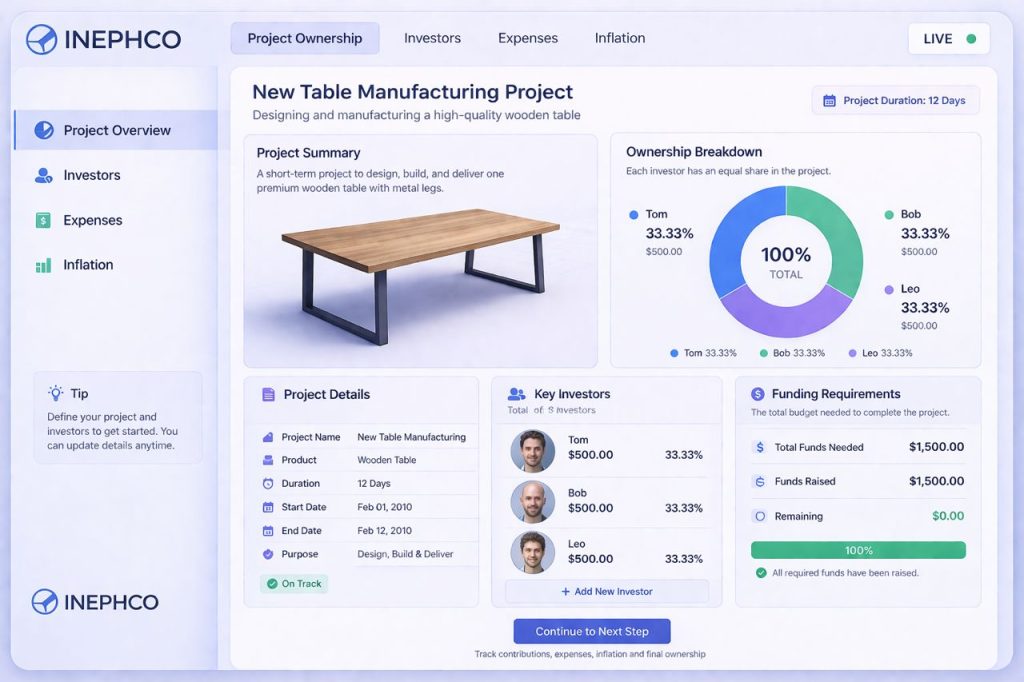
1. Project registration:
Set up your project by defining its basic details, including timeline, budget, and investors.
(Define your project by entering key details such as project name, duration, total budget, and participants. This step creates the foundation for all future calculations and analysis.)
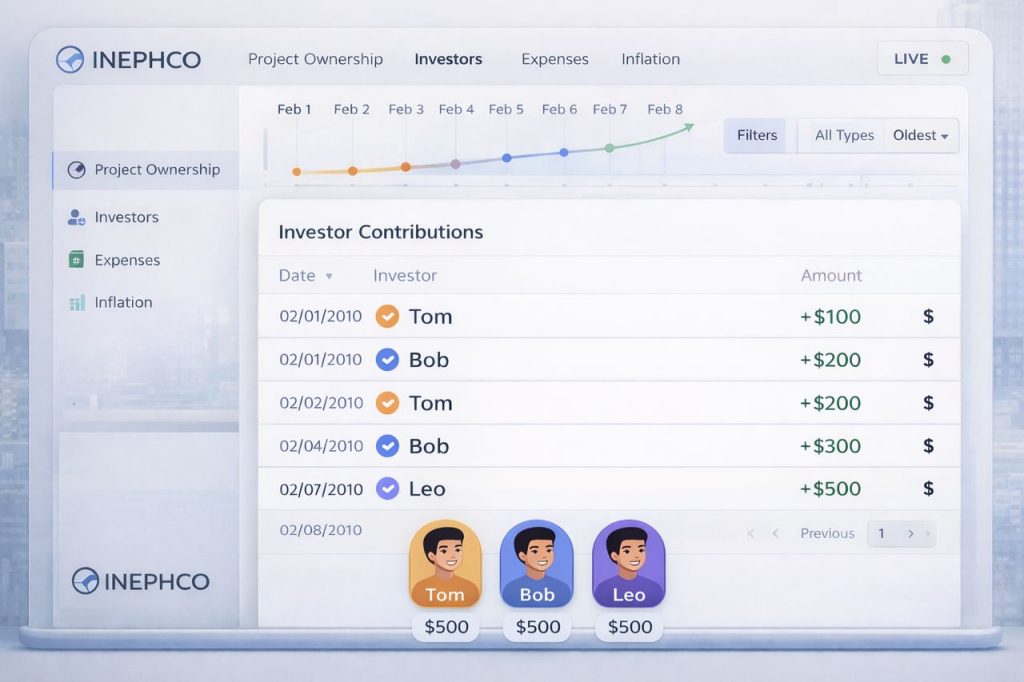
2. Add investors’ contributions:
Enter each investor’s contributions by recording the amount and the exact date of each transaction. This allows the system to track when capital enters the project and ensures accurate ownership calculations over time.
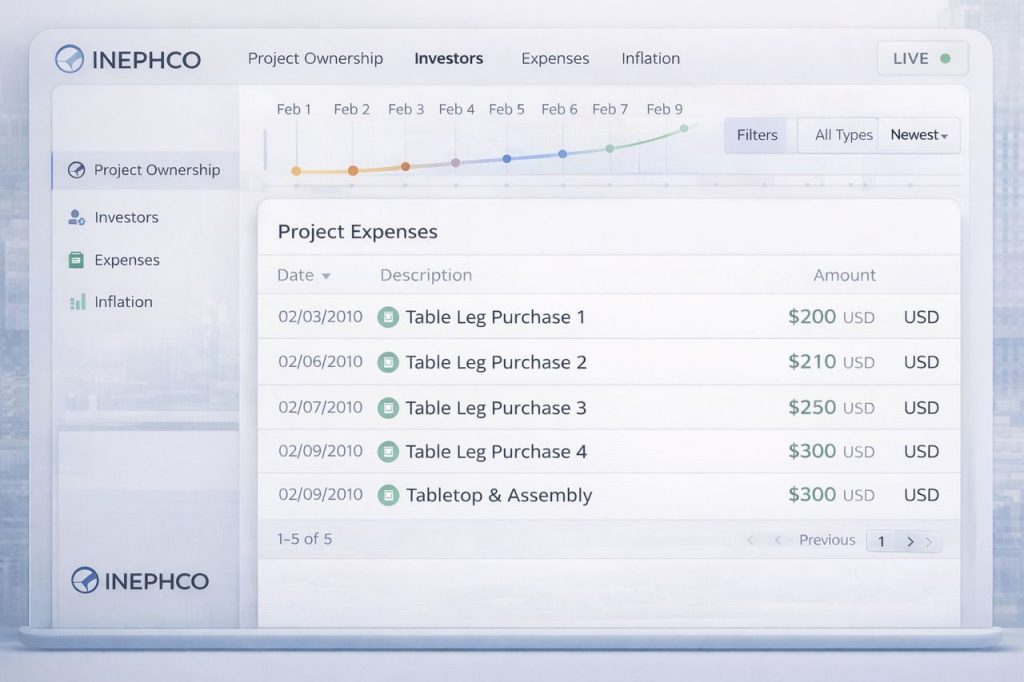
3. Add expenses:
Capture every project cost with precise timing and value, enabling the system to reflect real financial activity in ownership calculations.
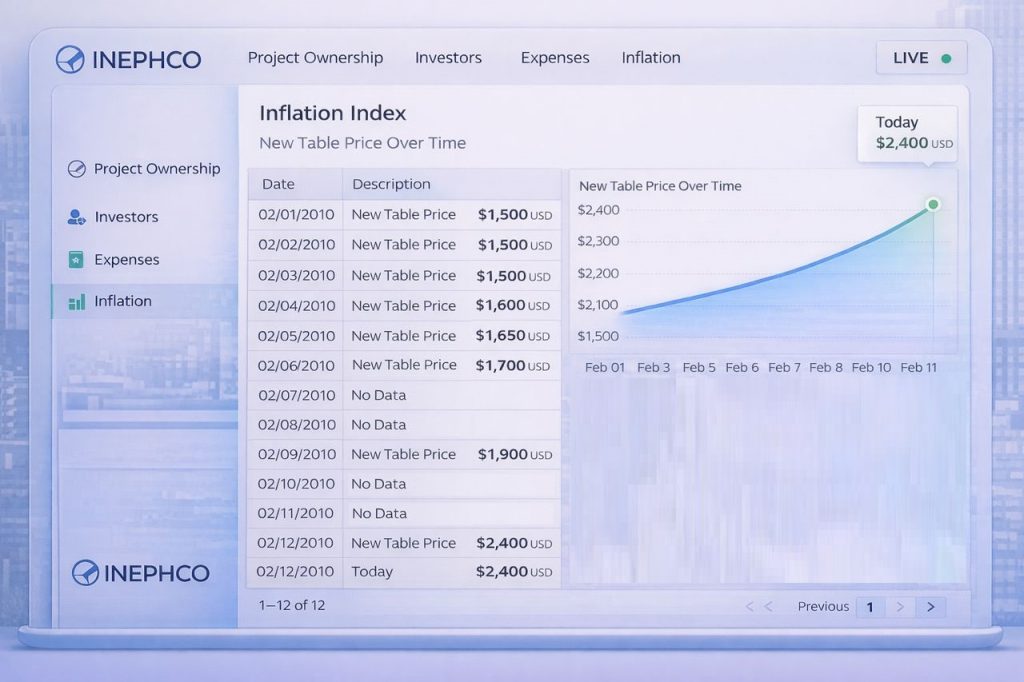
4. Apply inflation Index:
Enter inflation data over time by recording index values with their corresponding dates. For dates where inflation data is not available, the system automatically estimates and applies the appropriate rates to ensure continuous and accurate calculations.
5. Calculate & Reports:
Run the calculation to determine each investor’s ownership based on all inputs. The system then generates detailed and professional reports, providing clear insights into participation, financial performance, and final allocations.
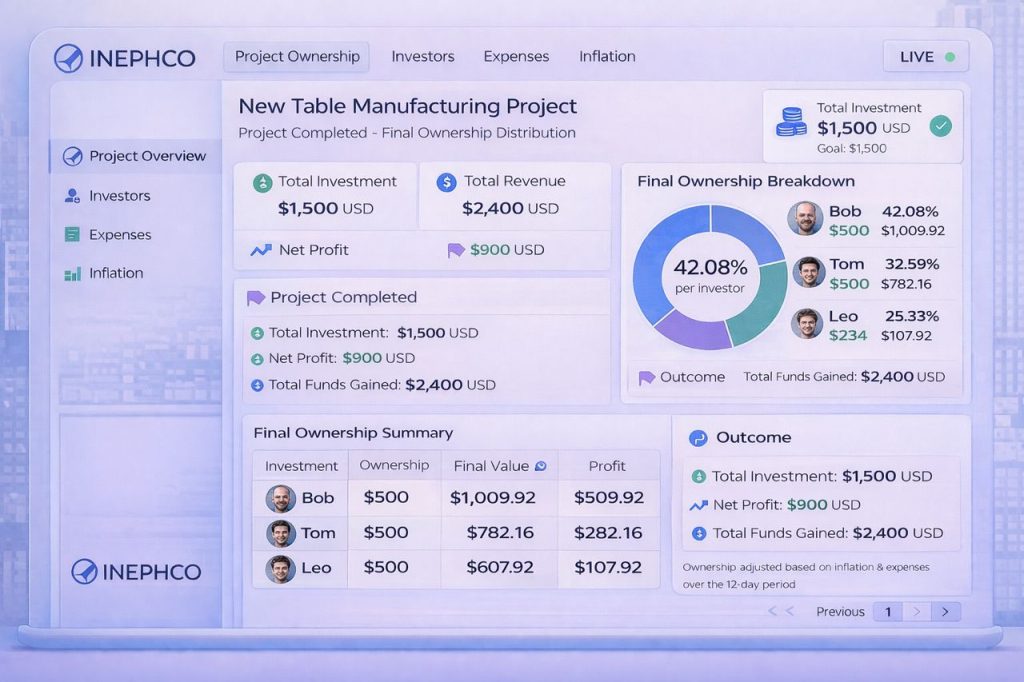
This example illustrates how ownership is dynamically calculated based on time, capital contributions, expenses, and inflation.
Although each investor started with an equal investment, the final ownership and profit distribution differ, reflecting their real economic participation throughout the project.
Priority Rights Allocation:
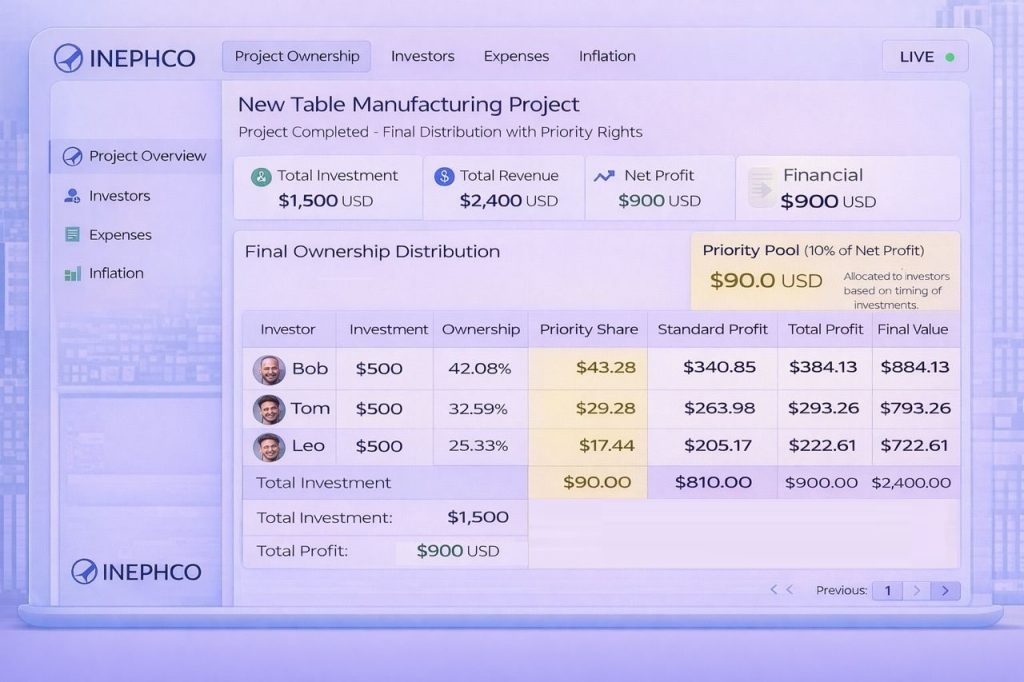
In this example, investors agreed that 10% of the project’s profit would be allocated as a priority reward for early participants.
Instead of distributing the entire profit based solely on ownership percentages, the system first separates a portion of the profit as a Priority Pool, then allocates it based on investment timing.
How It Works:
• The total project profit is $900
• 10% ($90) is allocated as the Priority Pool
• The remaining $810 is distributed based on ownership percentages
The Priority Pool is not distributed equally.
It is allocated in a way that rewards investors who entered the project earlier, reflecting the higher risk and longer capital exposure.
Priority Distribution:
Based on investment timing:
• Bob: 48.09% → $43.28
• Tom: 32.53% → $29.28
• Leo: 19.38% → $17.44
Final Profit Distribution:
After combining priority rewards and standard profit:
• Bob: $384.13
• Tom: $293.26
• Leo: $222.61
Why This Matters:
This approach ensures that:
• Early investors are fairly rewarded
• Capital is priced based on time and risk, not just amount
• Profit distribution reflects real economic contribution